
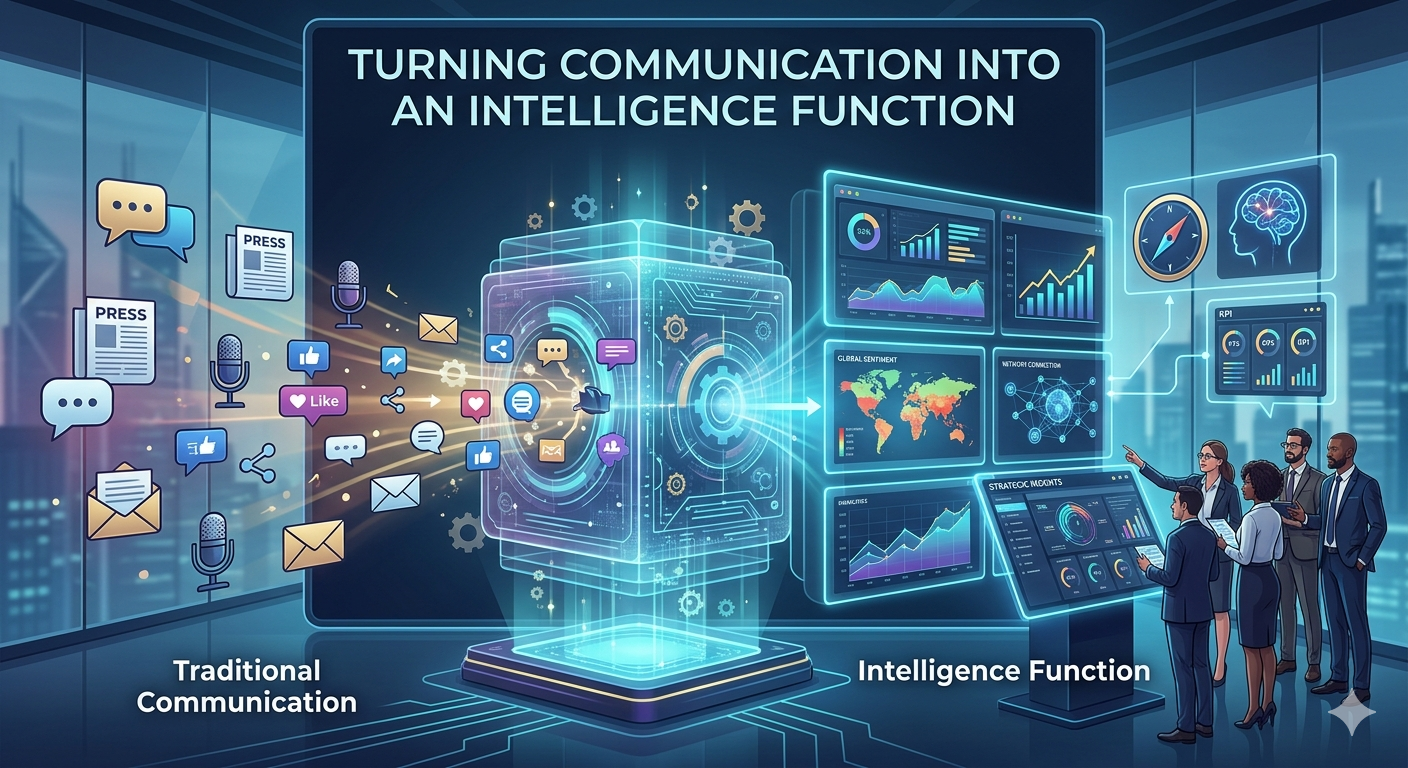
For ages, communication has been defined simply as an interlocution between two persons- the receiver and the sender. In recent times, corporate communication cannot be confined to messaging, media relations, or reputation management.
In recent times, modern corporate communication must evolve into a core intelligence function, one that not only tells the organisation’s story but also actively informs how that organisation thinks, decides, and responds to the world around it.
At its most fundamental level, communication has always served one primary purpose: to represent the business to the outside world. This includes shaping narratives, managing reputation, engaging stakeholders, and ensuring that the organisation’s voice is clear, credible, and consistent. Whether through media engagement, corporate storytelling, or digital platforms, communications teams have traditionally been the custodians of perception.
However, this is only half the job.
The role of communication is to represent the world back to the business. This means capturing insights, decoding stakeholder sentiment, identifying emerging risks, and translating external realities into actionable intelligence for leadership. In this capacity, communication becomes a strategic advisor, not just a messenger.
This dual responsibility requires a shift in mindset. Communication professionals must move beyond dissemination to interpretation. It is no longer enough to ask, “What should we say?” The more important question is, “What do we need to understand?”
Understanding stakeholders lies at the heart of this transformation. Stakeholders are not a monolith; they are diverse, dynamic, and often unpredictable. Customers, regulators, employees, investors, communities, and the media all interact with organisations differently, and their expectations are constantly evolving. Effective communication must, therefore, be grounded in deep stakeholder insight, not assumptions.
Yet many organisations still rely heavily on surface-level indicators, particularly social media metrics, as proxies for stakeholder sentiment. While social listening tools can provide useful signals, they are inherently limited. Social media represents only a subset of stakeholders and often amplifies the loudest voices rather than the most representative ones.
Relying solely on social listening is like trying to understand a complex market through a single lens—it creates blind spots. It can mislead leadership into overreacting to noise while missing deeper, more consequential trends.
To truly function as an intelligence unit, communication must adopt a multi-source, multi-stakeholder approach. This includes integrating insights from customer feedback, regulatory developments, employee engagement, market trends, investor sentiment, and traditional media analysis. The goal is to build a more complete and nuanced picture of the external environment.
In essence, communication must become the organisation’s “early warning system” and “strategic radar”, constantly scanning, analysing, and interpreting signals from the outside world to guide better decision-making.
For your communications team to be respected, it is important to ensure that these dual roles are professionally deployed.
Olutayo IRANTIOLA writes #PRQuotes weekly
Leave a Reply