
by
Olutayo Irantiola
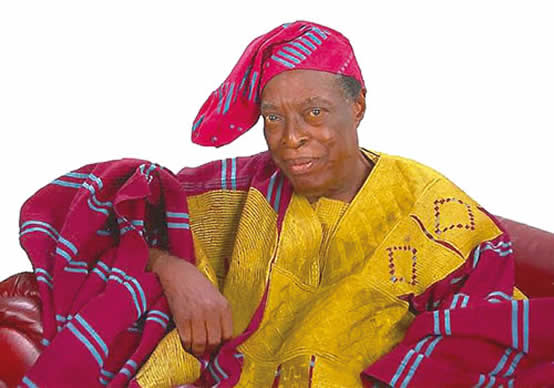
Alagba Adebayo Faleti is a tactful thespian who featured in many Yoruba movies. Alagba Adebayo Faleti, in many of his roles, represented the sage that is meant to correct, chastise and chaperon the Yoruba race. He can be described as the voice of the Elders and tradition. He drives his message through the use of songs, proverbs, illustrations and historical inferences in all the various movies he acted. Alagba Faleti’s cameo is very crucial to the denouement in all the movies. In this short analysis, we will examine some of the songs he used in some movies, his character and the importance of his role to society at large.
Saworoide is a satiric movie produced by Mainframe Films International in 1999. Alagba Faleti, he played the role of an Elderly Palace staff, Baba Opalaba, who has been enmeshed in the culture and tradition of the community by listening to various conversations whenever he pretends to be sleeping. He served the community by using music to warn, correct and reprimand. The first song in the play is-
Ko iye won,
Yoo ye won lola.
This song was based on the insistence of one of the chiefs who wants the new King to make riches, and unfortunately, that is not a part of the custom of the community. The literary translation of this song is that they do not understand now, they will understand tomorrow, and as such, they will soon come to the realisation of the consequences of their acts sooner or later. In whatever situation we find ourselves, we are expected to gain wisdom from it.
Oro leye n gbo o
Eye o dede ba lorule o
Oro leye n gbo o!
This song was to tell the chief, who regularly questions him, that he gathers information from his vantage point in the palace. This song is a way of admonishing people to be observant of what is happening around them.
Won ma le o/2ce
Awon ijoye yii ma le o,
Ajantiele
…
Yoo ma leyin/ 2ce
Oro yii yo ma leyin,
Ajantiele
As is typical of Nigerian and African politics, the electorate is often deceived by various candidates seeking electoral office. The rendition is a reminder to the political class of the repercussions of their various nefarious activities, which include heavy taxation, bribery and unfulfilled promises to the masses.
Alagisa n jo loru,
Boo pe ile a mo lola
This song is a futuristic warning of an impending shame for a person clad in rage. The significance of this song is that there are many people who carry out dastardly acts in the dark, but unfortunately, the day would break in a short while for everyone to see all that they assumed was hidden.
Asa n ba eyele sere,
Eyele n yoo,
Eyele n dunnu iku
Just like the Biblical saying about the relationship between light and darkness, so is the relationship between the hawk and the pigeon. The song is a description of the undiscerning relationship of the hawk and the pigeon; ironically, the pigeon does not know that death looms in the same relationship. This is a call on people to be discerning in their relationships.
Ojo to ro,
Ojo to ro ti o da,
Olorun lo ma iye eniti yoo pa!
This metaphoric song is connected with nature. Many people would definitely be affected by torrential rain; however, only God knows the exact number of people who would be drenched.
Similarly, in Iwogbe, a movie produced by Bayowa Films and Music International. Alagba Adebayo Faleti opened the movie with a short prelude. Alagba Faleti played Alhaji Kamarudeen Koya, also known as Abulesowo, a real estate connoisseur who believed in tradition. Alh Koya in the play represented the sanctity of traditional beliefs by remaining morally upright despite societal pressure to become a corrupt, rich man. Alh. Koya eventually was helpful to his client, who suffered from insanity.
Some of the songs that Alh. Koya used in the movie include-
Yoo san ko san,
Olorun ma fi were dan wa wo!
Yoo san ko san!
According to the Yoruba saying, “were dun wo loja, ko se bi lomo”, meaning an insane person is better watched in the market square rather than having as a child. This prayer song is beseeching God that we should not be afflicted with insanity, either curable or incurable.
Ile onirikisi,
Iri ni yoo wo!
This song admonishes hypocrites and evildoers to desist from their callous ways, or else all of their investment will be destroyed during their lifetime.
Eye tun ile se, (2ce)
Ere ikoko tun ile se demi o
Eye tun ile se!
There is nobody who loves a messy neighbourhood. This song is a call to the pigeon to tidy up the house for his arrival. This metaphorical song calls on people to ensure their character prepares the way for them ahead of the future event.
In Ejalonibu, a play written by Yemi Ademokoya and produced by Yemad Films Productions in 2001. Alagba Faleti was introduced towards the end of the movie as Baba. As typical of the Yoruba, “oro ti a ni ki Baba ma gbo, Baba ni yoo pari re” meaning the Father of the house would be finally consulted to resolve all the knotty issues that were previously hidden from him. The intervention of Alagba Faleti resolved the tension that had built up between the siblings. The younger brother is the surrogate father to his elder brother’s son. They had a prior meeting before coming to a larger meeting where the elders asked the son who he preferred to his father. The son said that since the elder brother paid his mother’s bride price, he remained the father. The only song that Alagba Faleti led in the movie goes thus-
Eru mi papo ju,
O ri pe orun wo mi,
O gba eru fun mi, o dogun,
Igba ti a de ibuso,
Oni ki n gberu kale,
Ki n gbori lasan lo ile wa,
Eemo loru o,
Iwo ko loni o
The song is a call on those who tricked their associates and converted what does not rightly belong to them into a forbidden parcel. This is one of the virtues that are fast depleting in our society, and it has become an albatross that has destroyed the concept of ‘Omoluabi’, which sets boundaries in our relationships with everyone.
Aside from playing roles adequately spiced with music, Alagba Faleti also took part in other movies in which he evidently showcased Yoruba culture, tradition, and history. He wrote Thunderbolt (Magun), a film produced by Mainframe Productions in 2001. He was an herbalist who interpreted the challenge of the Corps Member who is being maltreated Ngozi, an Igbo lady who is married to a Yoruba man, Yinka. She had been jinxed with Magun, and the cultural difference really deepens the issues around the so-called “African AIDS”. However, the use of incarnations was prominent in these movies.
Equally in another movie that he wrote, Afonja, produced by Remdel Optimum Communications in 2002, Alagba Faleti played the role of Oyedokun, an herbalist who dissuaded the king, Alafin Aole, from cursing the Yoruba race, but the King insisted. The movie is a historical film about the role of Afonja, the Aare Onakakanfo, in conquering the Alafin and how Ilorin was ceded to the Hausa/Fulani through Afonja’s power drunkenness.
Similarly, in the movie Ite Oba, directed by Segun Ogungbe and produced by Gemini Films in 2011, Alagba Adebayo Faleti played the role of Olori Ebi. The movie opens with the King’s passage, and the royal families are in contention for the throne. However, one of the princes whose family was not selected by the oracle wants to become the King at all costs. He eventually became the King, but with a taboo that his son’s wife inadvertently ran into. The family eventually had many catastrophic experiences, and the King did not enjoy the throne. Olori Ebi came with the wisdom of a sage, advising people to wait for their turn and not be forceful in seeking positions.
Alagba Faleti also featured in the 2011 movie Ijaodola, written by Lukman Balogun and produced by Jewiturn Movies Limited. In the movie, he was the King who joined the ancestors and this led to the struggle for the throne by the sons of the two Oloris. He appeared to two warring factions led by Balogun and Adifala, and he pleaded with them to desist from destroying the town. He reminded his sons of the charge he gave them years ago, encouraging them to be brave and guileless. He warned them to be discerning so that they would not be misled by praise singers and their advisers. This restored peace to the community.
In 2015, Alagba Faleti played the role of Asiwaju in the movie Eru Amukun (Sins of the Father), written by Kehinde Olayinka and produced by Olly-K Culture and Heritage Presentation. The movie is a reenactment of the journey to the independence of Feyinkogbon town from the British colonialists. The movie reflects the clamour of Nigerians, metaphorically represented by the Olugbon, Arese, and Orangun agitators. The sage in Asiwaju confronted the colonialist with the frank truth about the locals’ desire for independence, and he was permanently silenced by a gunshot in annoyance. The colonialists also deployed the divide-and-rule method to sow conflict among the agitators, thereby making them traitors.
Alagba Adebayo Faleti is a tree full of divergent fruits; he belongs to the generation of those who did not hold back all their talents in enriching the world. From his writings to his acting career, to his expertise in spoken words, both in poetry and in broadcasting. Alagba Faleti is a staunch cultural colossus, and his departure is a challenge for this generation to carry on the baton of promoting Yoruba culture, literature and language until it becomes a language that the world wants to associate with. Alagba Adebayo Faleti, orun ire o!
Olutayo Irantiola is a PR Specialist, Atọ́kùn, Yorùbá Lákọ̀tun, Book Reviewer, Creative Writer, Cultural Advocate, Poet, Citizen Journalist
Leave a Reply