
by Olutayo Irantiola
Just like every human culture and civilization, there are various wears worn depending on the occasion. I know times have changed; some clothes have gone extinct while some have transformed as it has crossed all the social divides. One attire that has been used across the social and cultural divide is the Agbádá. If you want to see glamorous Agbádás, they are usually on parade at various events and worship centres every weekend.
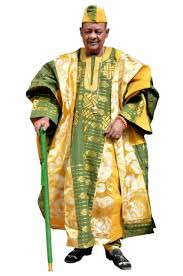
Agbádá is a very distinct wear of the Yoruba men. Although, in recent times, women have also found ways of wearing this overflowing attire. In times past, boys do not wear Agbádá, it was really for the men. It brings out the nobility in every man; it extrudes confidence and wealth and it attracts respect. It was associated with the Kings, Chiefs, and other influential people in the society. If you want to know the description of democracy among the Yorùbás, it is called Ìjọba Agbádá.
As some presume, Agbádá was not for any other use other than for important events. To showcase the beauty of the wear, it is usually heavily embroidered both at the front cum chest and the back. They usually attach the definition of deep pocket personality to anyone wearing Agbádá and interestingly, the pocket in front of the attire is usually deep.
There are four major types of Agbádás, these are-
Dandogo is referred to as the king of Agbádá. It is usually made with aso-oke. It has two pockets in the front. The neck is slit- never triangle or round. Only Ẹsikí, also called Dàńsíkí, is worn under it. For a tall man, the Ẹsikí, or Dàńsíkí could be the size of a Sapara. In order to reveal the beauty of the dress when worn, the large sleeves are underlined with different fabrics that present a sharp and beautiful contrast when worn. There are delicate embroidery works in the front and the back.
Yoruba people eulogies Dandogo by saying “Dandogo kọja aṣọ abi’nu da, Dandogo ki ise aso omode” literarily meaning Dandogo garment is beyond a cloth that can be grudgingly made to prove a point of affluence; it is not for small boys. To make this type of robe requires the skills of spinners, dyers, weavers, tailors, and embroiders. It is intentionally large, so the man wearing it appears larger than normal, thereby projecting an image of prosperity and power. At times, the sokoto is called kęmbę and it could also be worn with the normal sokoto with embroidery.
The befitting cap for Dandogo is Abeti-Aja or an Oba’s crown. Conventional fabrics could be used for dandogo, but its splendor is always emphasized by aso-oke. It will also interest you to know that some rich people use the fabric of Dandogo to make a matching pair of shoes.
Another One is the normal Agbádá nla, it is usually neck shaped with embroidered triangles (jakan). Sometimes, there may be elaborate embroidery designs front and back. In the late 1950s, round neck agbada was introduced and it has become popular since then.
Another type is called Agbádá Sapara. During the colonial period, in the 1920s, a Yoruba medical practitioner, Dr. Oguntola Sapara, redefined Agbádá by using a short overflowing, and less heavy material. This Agbádá is called Sapara. It is smaller, less voluminous, and often made of light, plain cotton. It is usually just a little after the knees. In today’s world, younger men have embraced this form of Agbádá for ease of simplicity and style.
In my findings, there is another one called Agbádá Oyala Eleri or Onikani. As described, it is like Sapara but it has a slight difference in the neck design. It rarely has embroidery, and it does not have a pocket at the front.
There are typically two forms of wear worn under Agbádá; the Bùbá and Ẹsikí, also called Dàńsíkí in some communities. The Buba is like a shirt and it can be made with long and short sleeves while Ẹsikí or Dàńsíkí is like smaller loose wear like the Agbádá.
Until recent times, the small fabric used for Agbádá is also used for the Bùbá and Ẹsikí and also the trouser. However, in recent times, Kampala or adire is indigo-resist dyed cotton cloths. It is usually soft, durable, breathable and very comfortable fabric. High-quality adire is considered the strongest natural textile in the world. Now, kampala is used for making Agbádá that is worn alongside other fabrics for various events.
Beyond these three different forms of Agbádás, I will want to take you on a traditional journey, the one worn by traditionalists or herbalists, as people call it. Underneath it, what they wear is called Èjìká Ogun which is loosely translated as Shoulders of War. This is akin to a “war chest”. Also, there is another type of the Agbádá that is not worn, it is sewn and kept in the house. This Agbádá records the voice. This is the reason why “powerful” men set restrictions and boundaries for their wives in their houses because of the presence of this attire.
Let’s tone it down to some to-dos and don’ts when you wear either Agbádá Dandogo, Agbádá nla, Agbádá Sapara or Agbádá Oyala Eleri:
1. Ensure that the collar of the Agbádá is on your neck. Today, many people make the mistake of wearing an Agbádá that the collar is well aligned to their neck. Once Agbádá falls off your neck, it loses the full beauty of the embroidery as it becomes distorted and the exquisite look becomes lost.
2. The Cap: Whenever you are in Agbádá, a complementing cap is very essential so that you can be formally dressed. The cap depends on whom you want to be perceived as. There are a series of caps, and this is another topic on its own.
3. The 1500 folding: Another thing that needs to be mastered is the way to fold the Agbádá so that it looks dapper. This gives the look of the man wey sabi!
4. Be respectable: As a respected attire, it is expected that the behavior and carriage of anyone wearing Agbádá should also be respectable.
5. Accessories: Agbádá is usually worn with good accessories, depending on the event. Some people wear the traditional red beads both on the neck and the wrist accompanied by a good wristwatch.
6. Nice Footwear: it is ideal to wear a leather shoe either full or half on an Agbádá. Whichever accessories bring out the Royalty in you, you will steal the show, definitely. Agbádá in any form is not to be complemented with laced shoes. But a lot of things happen these days in the name of fashion.
7. Don’t toy with any equipment: The overflowing nature of Agbádá makes it a disadvantage to wear near any sort of equipment or any automated wheel like a power-generating set. In fact, it takes so level of expertise to wear Agbádá and drive a car!
8. Don’t wear socks: Although there is a lot of innovation entering our dressing sense in recent times but a pair of socks on Agbádá is not appropriate.
It is another weekend. Get your Agbádá ready and let’s storm the various events in town! You will earn some respect when you appear as in a beautifully embroidered Agbádá
Leave a Reply