

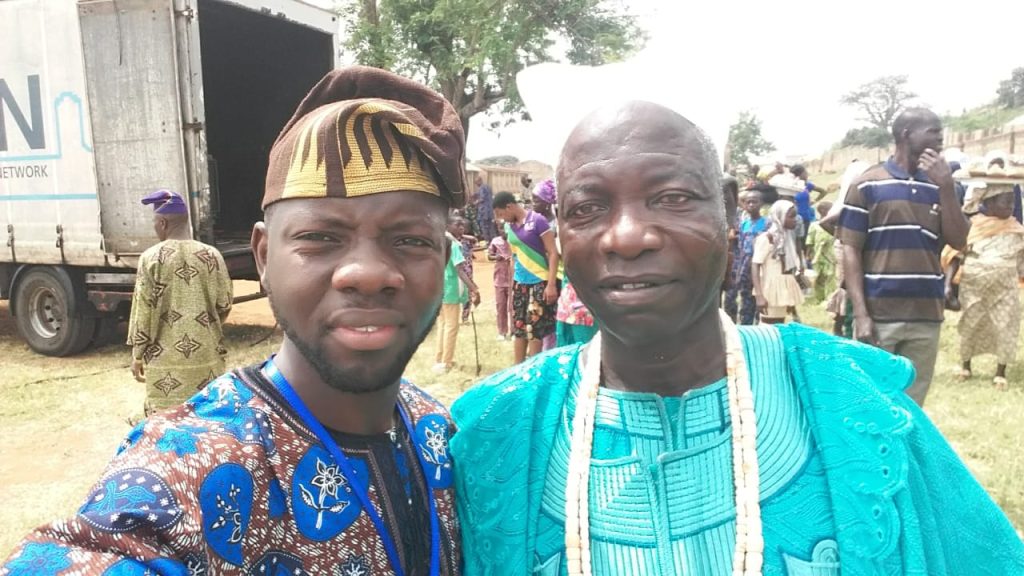
During the recently concluded Okeho Centenary Celebration, the Alasia of Isia Quarters in Okeho, Chief Rafiu Gbolagade Okunlola, Abiola II, was seen in a White Cap similar to the White Cap Chiefs of Lagos. Our reporter spoke with him about the cap and the history of the Isia people. Herein below is an excerpt of the translated interview–
PDC: Sir, we noticed that your White Cap is similar to those of the White Cap Chiefs in Lagos. Is it the same?
Alasia: It is similar but different; our cap is taken from our ancestry. Our ancestors migrated from Ìlá Òràngún in Osun State. They were the initial occupants of Isia forest. Our ancestors did not cut their hair at a young age; as such, the cap was usually left open. However, over the years, we evolved and started to close the cap’s peak; it has been modified. As for the white-cap chiefs in Lagos, they usually tilt their caps to the back.
PDC: Sir, you mentioned now that Isia Quarters is from Ìlá Òràngún, but some claim that Alasia Egbeji, the founder, is related to Isia located at Saki?
Alasia: We are not related to those at Saki; undisputedly, Isia is also at Saki. When I ascended the throne of my fathers, I went to Ìlá Òràngún to know the compound where our ancestors hailed from, when, I got to the King, I recited our praise chant (oriki) and we were directed by an old woman us to the compound that shared the same praise chant. Interestingly, the compound is identical to ours in Okeho. All the canes used during the Esan Isia festival is vividly drawn on the walls of the compound.
We have different traditions from the Alasia in Saki. He also uses the same white cap as mine, but his horsetail is usually Black but we must not use any other horsetail aside from white (cuts in)
PDC: Why can’t you use another colour of horsetail?
Alasia: Ours is white, that was how our fathers handed it over to us. We can wear all fabric colours except red but for the Alasia in Saki, he wears just white. Also, the way in which they celebrate their festival is different from ours- they would turn the mortar and jump around it. For us, when we celebrate the 7-day Esan Isia Festival, we use cane. On the day of the grand finale, we would be well dressed, and we would go get canes, we would face one another, and we would joyfully be singing, “bi orukundu, bi egbeji ni gbo, bi a o reni lu, ana ara wa.”
PDC: Thank you, Sir, for the exposition.
Alasia: You welcome.
Leave a Reply